
Prominently located at Weirs Beach overlooking beautiful Lake Winnipesaukee, the NHVA offers a unique retreat reserved for veterans and their families. Steeped in more than 150 years of history and tradition, the NHVA has served generations of veterans and their families as a place to gather, reconnect, and enjoy the camaraderie that comes with shared service.
Situated on nine acres along Lake Winnipesaukee, the NHVA offers veterans and their families an opportunity to step away from everyday life and enjoy everything the Lakes Region has to offer. Our historic cottages, some dating back to the 1800s and capable of accommodating groups of up to 16 people, provide a setting unlike anywhere else in New Hampshire. For those who prefer camping, our grounds can accommodate everything from traditional tent camping to RVs.
The NHVA is more than simply a place to stay. It is a community built by veterans, for veterans. It is a place to spend time with family, reconnect with fellow veterans, share stories around a fire, enjoy the lake, and continue the traditions established by generations of veterans who came before us.
Whether you are visiting for the first time or returning to a place that has become part of your family’s tradition, we hope you feel the same sense of belonging that has made the NHVA special for generations.
Welcome to the NHVA.
THE NEW HAMPSHIRE VETERANS’ ASSOCIATION (NHVA) is the only organization of its kind in the United States, with a reservation equally as unique in character. The NHVA is an organization that includes soldiers, sailors, marines, members of the Army Nurse Corps, who served in the War of 1812 or the Civil War through the present, or Sons of Veterans’ organizations, who are residents of New Hampshire, or connected with New Hampshire units in the service.
The NHVA’s headquarters and other buildings on the almost eight acres of ground, owned and administered by the Association, are situated in one of the most beautiful areas of the State. The grounds of the Association rise from the shore of Lake Winnipesaukee at The Weirs to a height that affords an excellent view of the lake. Here, members of the Association gather in convention and meet for reunion with their associates. During the warm months, they may find here either a quiet retreat or a chance to mix in the activities on shore and water provided at this lakeside resort. There are all sorts of amusements for leisure hours: boating, fishing, picture shows, and many other attractions.
THE NHVA IS THE NATURAL OUTGROWTH OF THE CAMARADERIE which binds men and women together in time of war, and of the desire to perpetuate the friendship in days of peace. The idea of forming this unique body – the only one of its kind in the United States – grew out of regimental organizations formed after the Civil War.
The Association was formed in 1875 as a result of the reunions held in Manchester and at The Weirs in 1878. The reunions helped renew the ties of friendship and loyalty that had been forged in the camps, hospitals, prisons, and on the battlefields. Articles of Incorporation were granted by an act of the General Court of New Hampshire on July 7, 1881. When originally organized, the membership of the Association consisted of men who had served in the armed forces of the Union on land and sea during the Civil War, All veterans, resident in New Hampshire who have served in the Armed Forces of the United States since then, are eligible for membership.
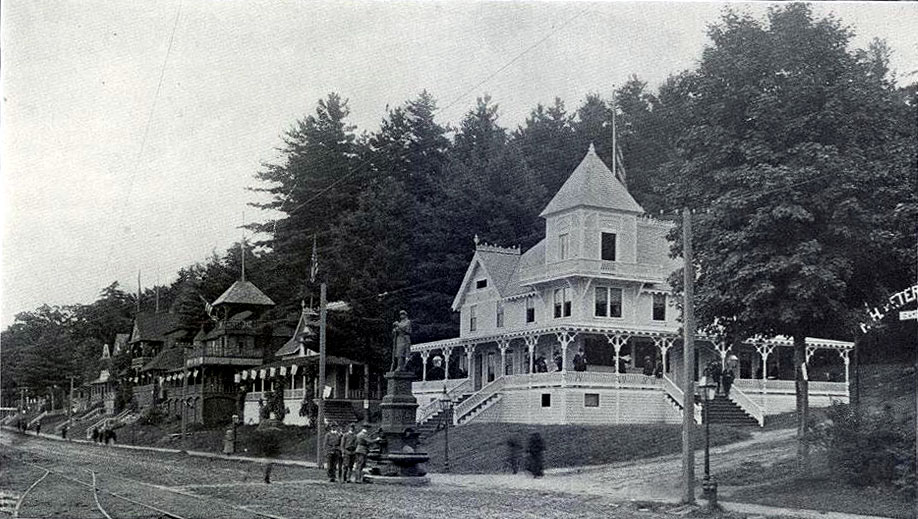
The site chosen as a home for the Association would be hard to duplicate in this or any other state. The 7.7 acres of land now occupied by the Association at The Weirs and within the city limits of Laconia, slope upward from Lake Winnipesaukee. The property offers a beautiful view of both lake and the White Mountains beyond. This property belonged to the B & M Railroad when first occupied by the Association, and was leased to it for 43 years, Then the General Court, by making adequate appropriations for it, enabled the Association to buy the entire tract of land for the railroad. This it did in 1924 for the sum of $4000. This property now belongs to the NHVA and has only one proviso attached, namely: “That whenever said corporation, form any cause, shall become extinct and cease to exist as a corporation, then all the property, real, personal, or mixed, shall be and become the property of the State of New Hampshire to be used and expended by said State for charitable purposes and non other.”
The property once boasted of a big open air auditorium having a seating capacity of 2,000. The outdoor auditorium occupied the entire hillside with the regimental buildings arranged around the outer rim. On the speaker’s platform has appeared many famous men and women. A glance at past programs reveals names of Grant, Sherman, Sheridan, Roosevelt, and many others who made military and naval history of the Country.
The buildings on the property include regimental and veterans’ organizations houses. When the land was first acquired, tents were used and the first permanent building was erected by the Lowell Association, which was made up of New Hampshire soldiers. After this, land was plotted out for the different regiments and the first headquarters building was erected on the hill where the Manchester building stood.
In 1944, an auxiliary was formed to be known as the New Hampshire Veterans’ Association Auxiliary. A section of the NHVA by-laws reads as follows: There shall be an Auxiliary to the NHVA know as the NHVA Auxiliary, made up of wives, mothers, daughters, and sisters of veterans who have faithfully in the aforementioned services of the United States, and who have received an honorable discharge therefrom, and of Sons of Veterans’ organizations in the NHVA, also members of Auxiliary bodies of organizations participating in the NHVA.
Although the Association was formed to foster the friendship which began during days of armed service to our country, its purpose is not confined to the fellowship of its members, but extends in days of peace to our relationship as citizens of the republic and as guardians of the colors under which we fought and the preservation of all that those colors represent.